Home › Recipes › Dessert ›Kurdish ›Kurdish Qudrat Halwa with Toasted Walnuts
DESSERT

Kurdish Qudrat Halwa with Toasted Walnuts

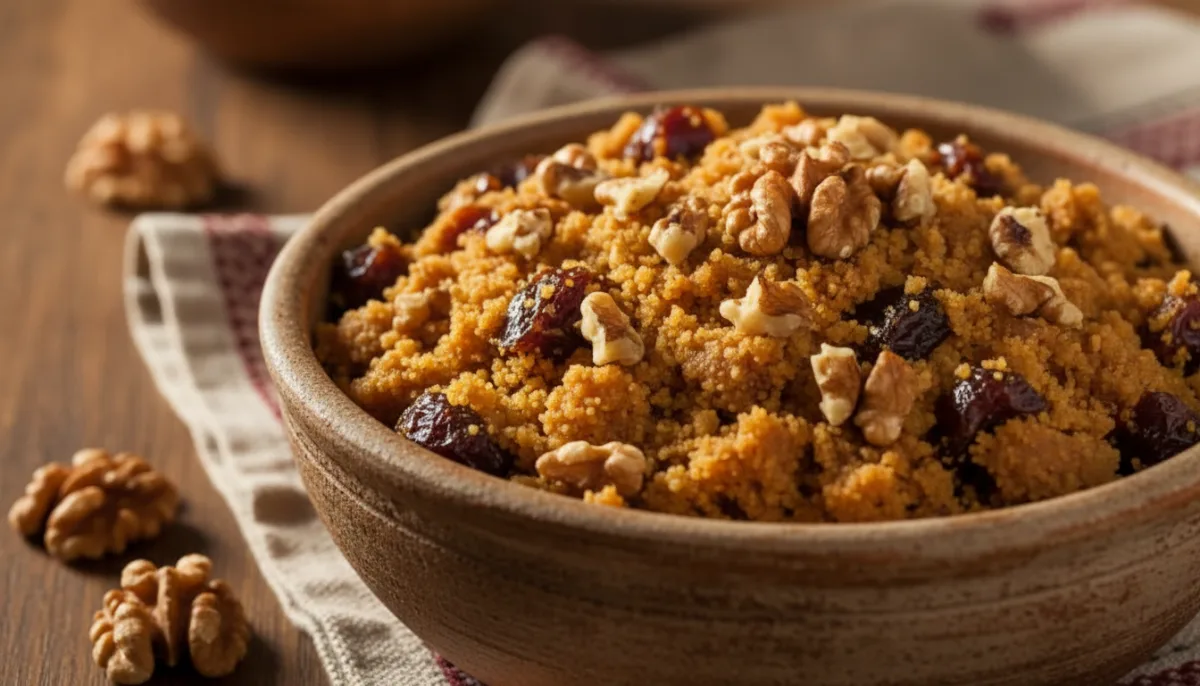
Indulge in the rich, comforting flavors of this authentic Kurdish Qudrat Halwa. This delightful dessert combines the natural sweetness of dates with the satisfying texture of semolina, elevated by the delightful crunch of toasted walnuts. It's a cherished treat, perfect for sharing during celebrations or enjoying as a warm, cozy evening indulgence.

✎
HOW TO MAKE IT

Let's cook.

01

In a medium saucepan, combine 2 cups water and 1/2 cup granulated sugar. Bring to a simmer over medium heat, stirring until the sugar dissolves. Remove from heat and set aside.

02

In a large non-stick pan or skillet, melt 1/2 cup unsalted butter over medium heat. Add 1 cup fine semolina and stir continuously for 8-10 minutes, or until the semolina turns a golden brown color and smells fragrant.

03

Carefully pour the warm sugar syrup into the semolina mixture, stirring constantly to prevent lumps. The mixture will thicken quickly.

04

Add 1 cup finely chopped pitted dates and 1/2 teaspoon ground cardamom to the pan. Continue to stir over medium-low heat for 5-7 minutes, until the halwa pulls away from the sides of the pan and forms a cohesive mass.

05

While the halwa cooks, toast 1/4 cup chopped walnuts in a small dry skillet over medium-low heat for 3-5 minutes, stirring frequently, until lightly golden and fragrant. Be careful not to burn them.

06

Press the halwa into a serving dish or individual molds. Garnish generously with the toasted walnuts.

07

Serve warm or at room temperature.

About This Recipe

Indulge in the rich, comforting flavors of this authentic Kurdish Qudrat Halwa. This delightful dessert combines the natural sweetness of dates with the satisfying texture of semolina, elevated by the delightful crunch of toasted walnuts. It's a cherished treat, perfect for sharing during celebrations or enjoying as a warm, cozy evening indulgence.
Kurdish Qudrat Halwa with Toasted Walnuts
Simple ingredients.
Big flavor.
✦
♨

Chef's Tips

For an extra rich flavor, you can substitute half of the water with milk in the syrup. Ensure your dates are very finely chopped to integrate smoothly into the halwa. A heavy-bottomed pan is best for cooking the semolina to prevent scorching.
↔

Easy Substitutions

Almonds or pistachios can be used instead of walnuts. For a sugar-free version, use a sugar substitute in the syrup and ensure dates are the primary sweetener. Ghee can replace butter for a more traditional flavor.
▱

Storage & Reheating

Store leftover halwa in an airtight container at room temperature for up to 3 days, or in the refrigerator for up to 1 week. Reheat gently in a microwave or on the stovetop with a splash of water if it becomes too firm.

Serving Suggestions

Serve alongside a cup of strong black tea or Kurdish coffee. A dollop of clotted cream or a sprinkle of cinnamon can enhance the flavors. It also pairs wonderfully with fresh fruit like sliced oranges or grapes.

Common Mistakes

Burning the semolina: Stir constantly during the toasting phase to prevent burning. Not stirring enough when adding syrup: This can lead to a lumpy halwa. Overcooking the halwa: It will become too dry and crumbly. Not chopping dates finely enough: Large date pieces won't integrate well. Using too much liquid: This can result in a runny halwa that doesn't set.

Frequently Asked Questions

Can I make this halwa ahead of time?

Yes, Qudrat Halwa can be made a day or two in advance and stored as directed.

What kind of semolina should I use?

Fine semolina (also known as semolina flour) is ideal for this recipe, as it creates a smoother texture.

Can I add other spices?

Absolutely! A pinch of saffron threads steeped in the warm syrup or a touch of cinnamon can be lovely additions.

Why is my halwa lumpy?

Lumps usually occur if the syrup is added too quickly or if the mixture isn't stirred continuously during the liquid addition.
MORE TO KNOW
The key to a perfect Qudrat Halwa lies in patiently toasting the semolina to a beautiful golden hue, which develops its nutty flavor. When adding the syrup, do so slowly and stir vigorously to avoid lumps and ensure a smooth, creamy texture. The halwa will continue to firm up as it cools, so don't overcook it to the point of dryness in the pan.
WHAT PEOPLE THINK

Reviews

☆

No reviews yet

Be the first person to review this recipe.

SHARE YOUR THOUGHTS

Made this recipe?

Tell us how it turned out.

Your review will be checked before appearing publicly.